- Remedial repairs fix defects in existing buildings, starting with the cause, not the symptom.
- Waterproofing, concrete spalling, cracking, facade defects and cladding top the list in Sydney.
- The process runs investigation, scope, specification, tender, then superintendence of the works.
- Owners corporations pay via the capital works fund or levies unless a warranty claim recovers it.
- An engineer-led scope stops a small patch becoming a much larger repair a few years later.
Remedial repairs are works that fix defects in an existing building rather than build something new. The leaking balcony, the spalling concrete in the car park, the facade crack that has reopened twice. They differ from maintenance in one respect that matters. Maintenance keeps a sound building sound. Remedial repairs start with something that has already failed, and unless someone works out why it failed, the repair will fail too.
In NSW that distinction has money attached to it. Building Commission NSW’s 2025 research found 53% of recently registered apartment buildings had experienced a serious defect in common property, and the 2023 round put the average rectification bill at $283,000 per building. Here is what remedial repairs involve in Sydney buildings, how the process runs from investigation to sign-off, and who ends up paying.
What are remedial repairs?
Remedial repairs are engineered works that rectify a building defect and its cause. A remedial engineer diagnoses why an element has failed, designs the repair, writes a specification a contractor can price and build from, and checks the work as it goes in. The repair itself might be simple. The diagnosis usually is not, because water, corrosion and movement rarely show up where they start.
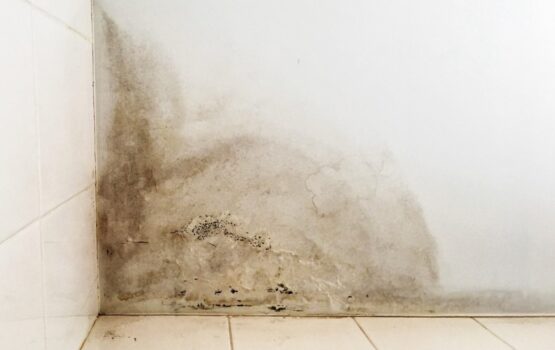
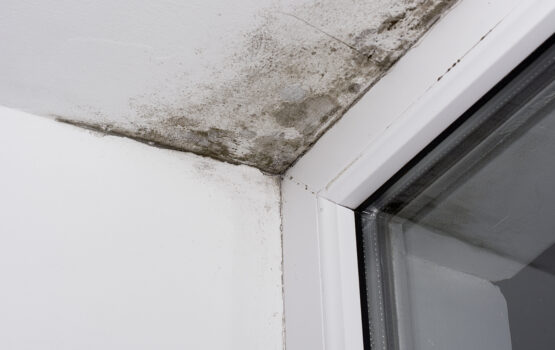
Take a stained ceiling in a ground-floor unit. The stain is the symptom. The cause could be a failed balcony membrane two floors up, a cracked planter box, a blocked scupper, or a window that was never flashed properly. Each has a different fix and a different cost, and only one of them is right.
Which defects do Sydney buildings get most?
Waterproofing failure is the most common serious defect in NSW apartment buildings, reported in 22% of buildings in the 2025 Building Commission NSW survey, with fire safety systems next at 16%. Those figures come from strata managers of buildings registered between 2018 and 2024. On older stock, which is most of Sydney, our inspections turn up the same five problems again and again.
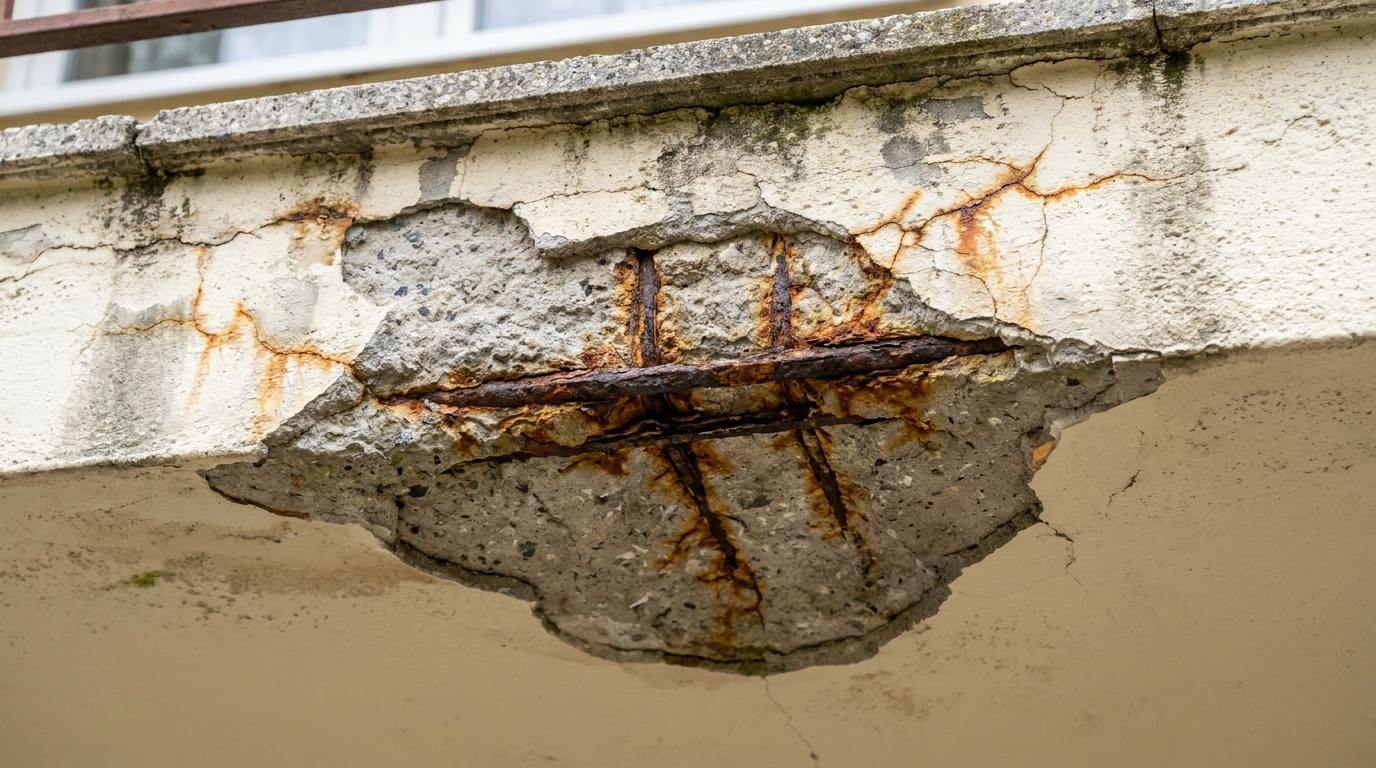
Concrete spalling (concrete cancer)
Moisture and chlorides reach the steel reinforcement inside concrete. The steel rusts, expands, and pushes the concrete off in flakes. You see it first on balcony edges, car park soffits and window heads. Left alone, it spreads along the bar and into the structural section, which is when a cosmetic problem becomes a structural one.
Waterproofing failure
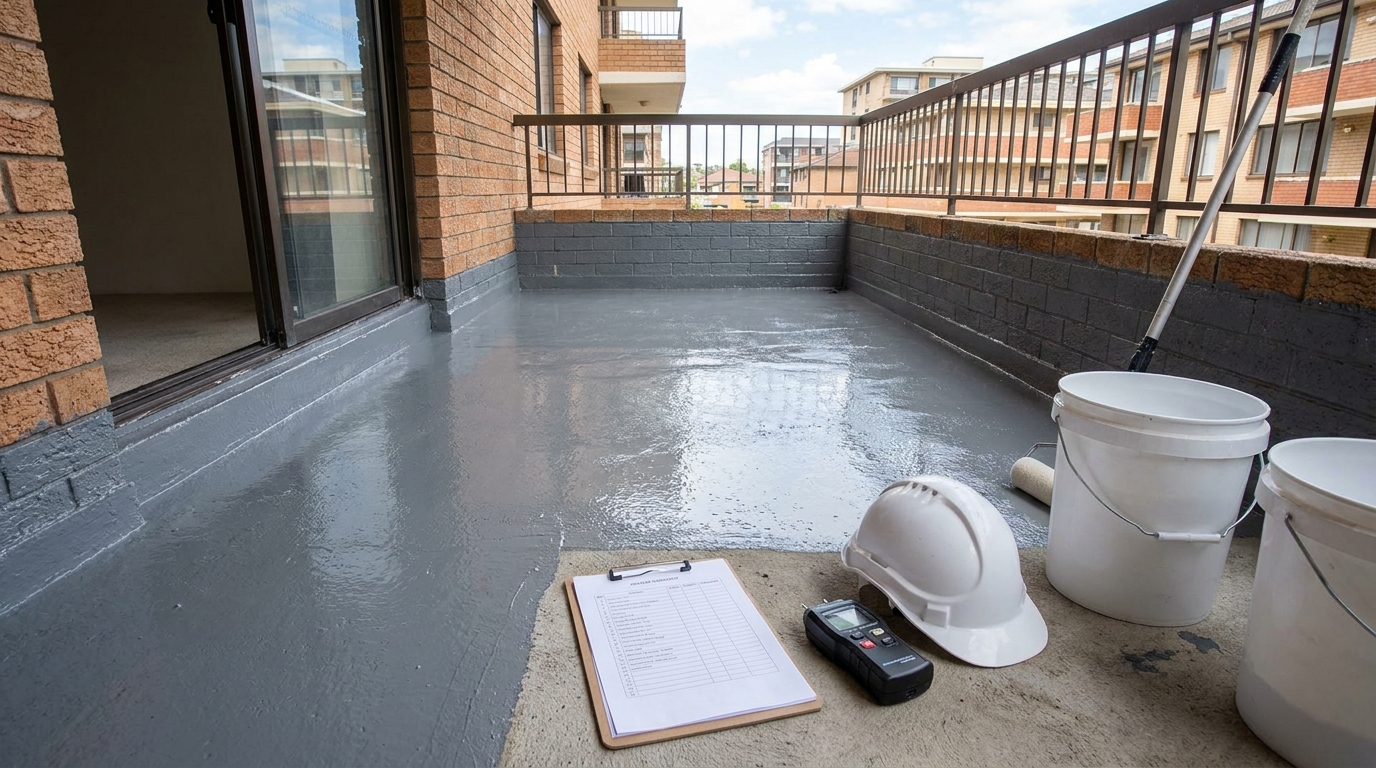
Balcony and bathroom membranes have a service life, and many were never installed to the standard in the first place. Failed hobs, missing upturns and tiled-over drains let water into the slab, the unit below and the facade. Water is also the usual trigger for the spalling above.
Cracking and movement
Some cracking is shrinkage and harmless. Stepped cracks through brickwork, cracks that widen over a season, or cracks paired with jammed doors point to footing movement or overloaded elements and need a structural engineer’s assessment before anyone fills them.
Facade and balcony defects
Drummy render, corroded lintels, failed sealant joints and balustrades that no longer meet the National Construction Code. Balustrades are a safety item and often the first thing a committee is legally obliged to fix.
Combustible cladding
Aluminium composite panels with a polyethylene core are banned for many uses in NSW, and affected residential buildings have been working through Project Remediate, the NSW Government program for replacing combustible cladding on eligible strata buildings. Cladding replacement is remedial work with a fire engineering component, and the design has to come from registered practitioners.
How does the remedial repair process work?
Done properly, a remedial project has five stages, and skipping any of them is where owners lose money.
Investigation. An engineer inspects the reported defects and the areas adjacent to and below them, takes moisture and cover meter readings, opens up finishes where needed, and writes a report that separates cause from symptom. On a strata building, this usually starts with a building inspection report.
Scope. The committee decides, with the engineer’s advice, what gets fixed now, what gets monitored and what waits for the next capital works cycle. Safety items and active leaks go first.
Specification. The engineer writes a technical specification describing methods, materials, hold points and quality requirements. This is the document every contractor prices against. A vague one produces quotes that cannot be compared and variations that cannot be argued.
Tender. Several specialist remedial contractors price the same specification. The engineer assesses the tenders on experience, methodology, materials and price, not price alone, and reports to the committee.
Superintendence. Under an AS 4000 style contract, the engineer acts as superintendent issuing directions, inspecting at hold points, assessing progress claims and variations, and certifying practical completion. The contractor stays responsible for its workmanship. The superintendent is the one checking it.
Who pays for remedial repairs?
In a strata scheme, the owners corporation must maintain and repair common property, and balconies, slabs, external walls, membranes and structure are almost always common property. So the default answer is the owners corporation, meaning every lot owner in proportion to their unit entitlement.
The money comes from one of three places. The capital works fund, which NSW schemes must budget through a 10-year plan under the Strata Schemes Management Act 2015. A special levy, raised when the fund is short, which is the usual outcome for a large unplanned repair. Or a strata loan, repaid through levies over several years.
The fourth option is recovering the cost from whoever built it. Under the Home Building Act 1989, residential building work carries statutory warranties of six years for major defects (structure, fire safety, waterproofing) and two years for everything else, running from completion. Owners corporations can also complain to Building Commission NSW, which can issue building work rectification orders to developers of newer apartment buildings. By mid-2025 the Commission had issued 208 of those orders, and at least 60% had not been fully complied with. An order is not the same as a repair.
For buildings four storeys and above completed under the Strata Building Bond and Inspection Scheme, a 2% bond lodged by the developer can also be drawn on for defects identified in the scheme’s inspection reports.
Timing Matters
Warranty periods run from completion of the building work, not from when the defect is noticed. If a building is approaching six years old and has any sign of water ingress or spalling, get the engineer’s report done and the claim lodged before the period closes. A breach that appears in the last six months buys an extra six months to start proceedings, and no more.
Why an engineer-led scope matters
The cheapest way to fix a defect is to fix it once. That sounds obvious, and it is the task that’s most often skipped. A committee gets three contractor quotes for ‘balcony repairs’, each contractor scopes the job differently, and the cheapest wins. Eighteen months later, the leak is back because nobody diagnosed the hob detail that caused it.
An engineer-led scope changes that in three ways. Every contractor prices the same specification, so the quotes are comparable. The hold points mean the membrane gets inspected before it is tiled over, not after it fails. And when a contractor claims a variation for ‘unforeseen’ conditions, someone with the training to judge whether it really was unforeseen is holding the pen.
MJ Engineering Projects has worked this way on Sydney buildings since 2007, from three-storey walk-ups in Lane Cove to towers under Project Remediate. If your building has a defect and you are not sure what you are looking at, a site-specific assessment is the place to start.
Frequently Asked Questions
What is the difference between remedial repairs and maintenance?
Maintenance is planned work that keeps sound elements in service: repainting, resealing joints, clearing drains, servicing plant. Remedial work responds to a defect that has already occurred and involves diagnosing its cause, designing a fix and rebuilding the failed element. A good capital works plan funds both, but remedial work tends to arrive as a special levy because nobody budgeted for the membrane to fail.
How long do remedial repairs take on a strata building?
It depends on scope and access. Investigation and specification typically take a few weeks to a couple of months, tendering four to six weeks, and construction anywhere from a month for a single balcony line to a year or more for whole-building facade and concrete works. Occupied buildings need staging so residents keep access, which adds time.
Can we just get quotes from remedial contractors and skip the engineer?
You can, and for a small, clearly understood repair it may be fine. For anything involving water ingress, concrete spalling or structural cracking, it is a false economy. Without a specification, each contractor scopes the job differently. The quotes cannot be compared, and there is no independent check on the work or on variation claims once it starts. There is also a legal limit to the do-it-yourself approach. On a regulated building, which includes apartment buildings, the Design and Building Practitioners Act 2020 requires regulated designs, waterproofing and load-bearing structure among them, to be prepared and declared by a registered design practitioner. The low-value exemption in the regulation stops at $5,000, so beyond a genuinely minor repair the design has to come from a registered practitioner regardless of how the quotes are obtained.
Our building is seven years old and has concrete spalling. Is a warranty claim still possible?
The six-year statutory warranty for major defects under the Home Building Act 1989 runs from completion, so a straightforward claim is likely out of time. There can be other avenues, including claims under the Design and Building Practitioners Act 2020 duty of care, which has a longer reach, so it is worth getting an engineer’s report and legal advice quickly rather than assuming the door is shut.
If your building has a defect and you want to know what you are dealing with before committing to a repair, contact MJ Engineering Projects on 1800 953 935 for a site-specific assessment.
About the Author
MJ Engineering Projects, Remedial Engineers, Sydney
MJ Engineering Projects is a Sydney remedial engineering firm working on building defects across residential, commercial and strata buildings. This article is general information about remedial repairs and building defect rectification, not engineering or legal advice for a specific building. For your situation, get a site-specific assessment.
Sources
References for statistics and claims cited in this article.
- Building Commission NSW, Research on serious building defects in NSW strata communities (2025 findings: 53% of buildings with serious defects, waterproofing 22%, fire safety 16%, 36% reported to regulator): nsw.gov.au
- Building Commission NSW, Survey shows serious defects down in newer apartment buildings (2023 survey release): nsw.gov.au
- LookUpStrata, NSW: 2023 Strata Defects Survey Highlights (average rectification cost $283,000 per building): lookupstrata.com.au
- Building Commission NSW, How Building Commission NSW deals with building defect complaints (statutory warranty periods and major defect definition): nsw.gov.au
- ABC News, 10 July 2025, Building Commission NSW fails to seek fines for developers that lag on defect orders (208 rectification orders, at least 60% not fully complied with): abc.net.au