To fix spalling concrete, you remove the corrosion-damaged concrete, treat the steel reinforcement inside it, and rebuild the element so the deterioration stops. Done properly, it is a structural repair carried out to a specification. Done as a cosmetic patch, it is a repair you will pay for twice, because the corrosion that caused the spalling keeps running underneath the new render.
Here is how the full process works on Sydney buildings, from the first rust stain to the finished restoration, and where the shortcuts hide.
What Is Spalling Concrete and Why Does It Happen?
Spalling concrete, often called concrete cancer, starts with the steel, not the concrete. Fresh concrete is highly alkaline, which keeps the reinforcement inside it passive and rust-free. Over the years, carbon dioxide penetrates the surface and lowers the alkalinity (carbonation), or chlorides from salt-laden coastal air reach the bars. Either way, the steel starts to corrode, and rust occupies several times the volume of the steel it came from. That expansion cracks the concrete cover from the inside and eventually forces it off in flakes and chunks.
The common accelerants we find on Sydney buildings: water ingress through failed waterproofing, reinforcement placed with too little concrete cover during construction, cracked or poorly compacted concrete, and corrosive magnesite floor toppings sitting on slabs for decades. Sydney’s coastal suburbs get the chloride problem on top of everything else.
This is why spalling is a defect with a cause, not just damage with an appearance. Repair the concrete without fixing the water path or the exposure, and you have paid for a countdown timer.
The Warning Signs, in the Order They Appear
- Rust staining – bleeding through paint or concrete surfaces, usually the first visible sign
- Hairline cracks tracking in straight lines – following the reinforcement beneath
- Drummy concrete – which sounds hollow when tapped, because it has separated from the substrate
- Flaking and spalled chunks – typically at balcony edges, slab soffits and window heads
- Exposed brown reinforcement – the late stage, and a falling-object hazard on any elevated element
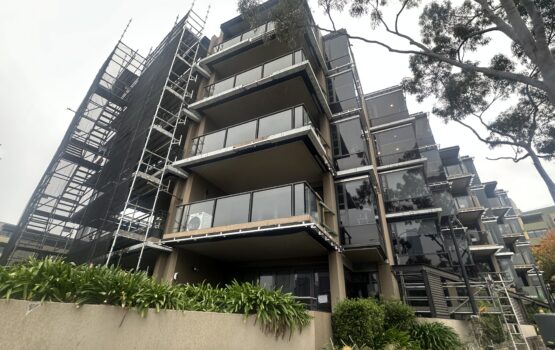
Each stage is more expensive than the one before it. Spalling never stops on its own: the longer corrosion runs, the more steel section is lost and the larger the structural repair. Loose concrete on a facade or balcony edge is also a genuine safety risk to people below, which is why owners corporations are expected to act on it rather than watch it.
Stage 1: Assessment and Diagnosis
Knowing how to repair spalling concrete starts with questions the eye cannot answer. How far does the delamination extend beyond what is visible? How deep has carbonation travelled? Are chlorides present? Is the cause a failed membrane above, or the original cover to the reinforcement?
The engineering assessment typically combines a visual and hammer-tap survey to map drummy zones, cover meter readings to measure how much concrete protects the steel, and, where the environment looks aggressive, testing of samples for carbonation depth and chloride content. The output is a scope: which areas need breakout, what caused the corrosion, and what has to change so it does not restart. On buildings with water involvement, this is where the spalling investigation meets a waterproofing assessment, because the two defects usually share a cause.
Stage 2: How to Repair Spalling Concrete
The method for repairing spalled concrete is consistent, and every shortcut version of it fails the same way.
Step 1: Break out to sound concrete
All drummy and damaged concrete is removed past the corroded steel to clean, sound material, including behind the bars. A breakout that stops at the visible damage leaves corrosion sealed inside the repair.
Step 2: Treat or replace the steel
The reinforcement is cleaned back to bright metal, usually by abrasive blasting, and coated with a corrosion-inhibiting primer. Where corrosion has eaten too much of the bar’s cross-section, new steel is spliced in to restore capacity. This is the step that makes it a structural repair, and it is engineered, not improvised.
Step 3: Reinstate with repair mortar
The profile is rebuilt with a proprietary structural repair mortar compatible with the parent concrete, applied and cured according to the manufacturer’s system requirements. Ordinary render or patching compound is where cheap repairs go to fail.
Step 4: Protect the surface
A protective coating or anti-carbonation membrane slows the next cycle of carbonation and keeps water out, where the diagnosis found a failed membrane, threshold or joint, which gets rectified in the same project.
Stage 3: Restoration and Prevention
On strata and commercial buildings, the repair is delivered under a technical specification, with hold points inspected before each stage is covered up: the breakout extent, the cleaned steel, and the mortar application. That is the difference between a repair you can warrant and one you have to take on faith. Our engineers prepare the specification, tender the works to specialised remedial contractors and superintend them to completion through our concrete spalling repairs service.
Prevention afterwards is unglamorous and effective: keep membranes, joints and drainage maintained so water stays out, recoat protective finishes on schedule, and put elevated concrete elements on an inspection cycle so the next rust stain is caught at the stain stage. For buildings under ten years old, spalling caused by construction defects such as inadequate cover may also be claimable under the statutory warranties in the Home Building Act 1989 (NSW), which makes early engineering documentation doubly valuable.
Why Patch Repairs Keep Failing
The pattern arrives in our inbox every month: a balcony patched two summers ago, now cracking around the edges of the patch. The reasons are always some combination of a breakout that stopped at the visible damage, steel that was painted over rather than cleaned, mortar that was really render, and a water source nobody investigated. The patch was cheaper. The second repair, plus access costs, plus the spread in between, was not.
If the quote for your spalling repair has no assessment stage, no breakout criteria and no steel treatment, you are not buying a repair. You are buying time, and not much of it.
Frequently Asked Questions
Is spalling concrete the same as concrete cancer?
Effectively, yes. Concrete cancer is the common name for the corrosion cycle, where rusting reinforcement expands and progressively breaks the concrete around it, and spalling is the visible result of that cycle. Both terms describe the same defect, and both call for the same engineered repair rather than a cosmetic patch.
How much does it cost to fix spalling concrete in Sydney?
It depends on the extent of delamination, access (ground level versus facade), and whether steel needs replacing. A localised early-stage repair is a fraction of the cost of widespread facade remediation with scaffolding. An assessment gives you a scoped, tendered price rather than a guess.
Is spalling dangerous, or just ugly?
Both, depending on the stage. Early spalling is a durability problem. Advanced spalling reduces the steel cross-section in slabs, columns and balcony edges, and loose concrete falling from height is a real hazard, which is why councils and owners corporations treat facade spalling as a safety issue, not a cosmetic one.
Can I just paint or render over spalled concrete?
No. Painting or rendering may temporarily conceal the damage, but it will not address the underlying concrete deterioration or reinforcement corrosion. Proper rectification generally requires removal of unsound concrete, treatment or replacement of affected reinforcement, reinstatement with a suitable repair mortar and application of any required protective coating.[1] [2]
Who is responsible for spalling repairs in a strata building?
Spalling in common property, which includes the structure, facade and balconies in most NSW schemes, is generally the owners corporation’s responsibility to repair. If the spalling stems from a construction defect in a newer building, the corporation may have a warranty claim against the builder or developer, which is where engineering evidence comes in.
Seen a rust stain or a drummy patch on your building? Get it assessed while the repair is still small. Get in touch with MJ Engineering Projects on 1800 953 935 or info@mjengineeringprojects.com.au.
About the Author
MJ Engineering Projects, Remedial Engineers, Sydney
MJ Engineering Projects is a Sydney remedial engineering firm working on building defects across residential, commercial and strata buildings. This article is general information about spalling concrete, not engineering or legal advice for a specific building. For your situation, get a site-specific assessment.